Korean bank, brokerage, pension and insurance accounts: what goes on the FBAR
Which Korean accounts count toward the $10,000 FBAR test: bank and housing subscription savings, brokerage, cash-value insurance, pension savings, and NPS.
最近更新: 2026-11-03
Most people who moved from Korea still have something there: an old 보통예금, a 청약통장 their parents keep paying into, a brokerage account, a 저축성 보험 policy, a 연금저축 account. If you are now a U.S. person, much of it may belong on the FBAR (FinCEN Form 114). The report is free and owes no tax. Missing it is what costs money.
Who files
You file an FBAR for a calendar year if:
- You were a U.S. person: citizen, green card holder, or resident under the substantial presence test. F-1 and J-1 students are usually nonresidents in their first five calendar years and do not file. Workers on H-1B, L-1 or E-2 visas usually meet the substantial presence test.
- You had a financial interest in, or signature authority over, accounts outside the United States.
- The highest balance of each account, added together, was more than $10,000 at any time in the year.
The test adds each account's own peak, even when the peaks fell in different months. At the Treasury rate for December 31, 2025 (1,443.75 won per dollar), peaks that add up to more than ₩14,437,500 cross the line.
What counts in Korea
| Account | Counts? |
|---|---|
| 보통예금 / 입출금 account, 정기예금 (time deposit), 적금 (installment savings) | Yes |
| Kakao Bank, Toss Bank, K Bank accounts | Yes: these are licensed banks |
| 청약통장 (주택청약종합저축) | Yes: a savings deposit at a bank |
| Securities account, CMA, ISA | Yes |
| Savings-type insurance, annuity or whole life with a surrender value | Yes: FinCEN lists cash-value insurance and annuities |
| 연금저축 (trust, fund or insurance type) and IRP | Conservatively yes: see below |
| Employer 퇴직연금 (DB/DC) | Unclear: see below |
| 국민연금 (National Pension Service) | Generally no: IRS treats foreign social security as not reported |
| 카카오페이 or 토스 prepaid wallet balance | Unsettled: no FinCEN guidance on e-wallets |
| An apartment, a 전세 deposit, or cash at home | No: not a financial account |
Ownership is about whose name is on the account, not whose money it is. An account in your name that your parents use is yours.
Joint accounts and signature authority
- Joint accounts. If you own an account together with a parent or anyone else, you report the entire value of the account, not your share, and list the other owner.
- Signature authority. FinCEN defines it as the power to control the money by instructing the bank directly. If the bank formally lets you move money from a parent's account, that account goes in Part IV of the report even though the money is theirs. The instructions do not address informally using a parent's online banking login; if that is you, ask a professional.
Pensions and insurance: what the sources actually say
Cash-value insurance is clear. FinCEN's FBAR instructions say a financial account includes "an insurance policy with a cash value" and an annuity policy with a cash value. Korean 저축성 보험, 연금보험 and whole life policies with a surrender value fit. The instructions do not give a valuation method for insurance; using the highest surrender value shown on the insurer's statements is a reasonable approach to confirm with a preparer.
The National Pension (국민연금) is generally not reported. The IRS chart comparing Form 8938 and the FBAR lists "Social Security"-type program benefits provided by a foreign government as not reported on either form. FinCEN's own instructions say nothing about foreign government pensions, so the IRS chart is the clearest official statement.
연금저축 and IRP are less clear, and the conservative answer is to report. These are accounts in your name at a Korean bank, brokerage or insurer, which is what the FBAR definition describes. The FBAR exceptions for retirement savings cover only U.S. IRAs and U.S. tax-qualified plans, not foreign ones. Employer 퇴직연금 plans are harder to call: whether you have a reportable interest may depend on how the plan is set up, and FinCEN has not addressed Korean plans. There is no penalty for listing an account you did not strictly need to report.
Old accounts from living in Korea
An account counts for every year it is open while you are a U.S. person, used or not. To find what is still open in your name, Korea's 어카운트인포 service, run by the Korea Financial Telecommunications and Clearings Institute, lists accounts across banks; it may require Korean identity verification. Closing accounts you do not need makes future years simpler.
Working out the number
For each account, find the highest balance during the year in won. Periodic statements are fine if they fairly show the peak. Convert with the Treasury Reporting Rate of Exchange for December 31 of that year and round up to the next dollar. For 2025 that rate was 1,443.75 won per dollar:
| Account | Peak in 2025 | In dollars |
|---|---|---|
| 보통예금 | ₩8,000,000 | $5,542 |
| 청약통장 | ₩5,000,000 | $3,464 |
| 저축성 보험 (surrender value) | ₩3,000,000 | $2,078 |
| Total | $11,084: file |
No single account is near $10,000, but together they are over.
Filing
- Where: online through FinCEN's BSA E-Filing system. Not with your tax return, and not by mail. There is no fee.
- When: April 15 of the following year, with an automatic extension to October 15. You do not need to request it.
- Penalty: a non-willful failure can cost up to $16,536 per report (amount for penalties assessed on or after January 17, 2025); willful failures are far worse. See FBAR late filing and penalties.
Form 8938 is a different test
Above $50,000 at year end or $75,000 at any time (single, living in the U.S.), you probably also attach Form 8938 to your income tax return. It is not a substitute for the FBAR: the thresholds differ, and so do some of the assets covered. Interest, dividends and gains from Korean accounts go on Form 1040 either way. See FBAR vs Form 8938.
Next steps
- Run the free FBAR checker: five questions, nothing stored.
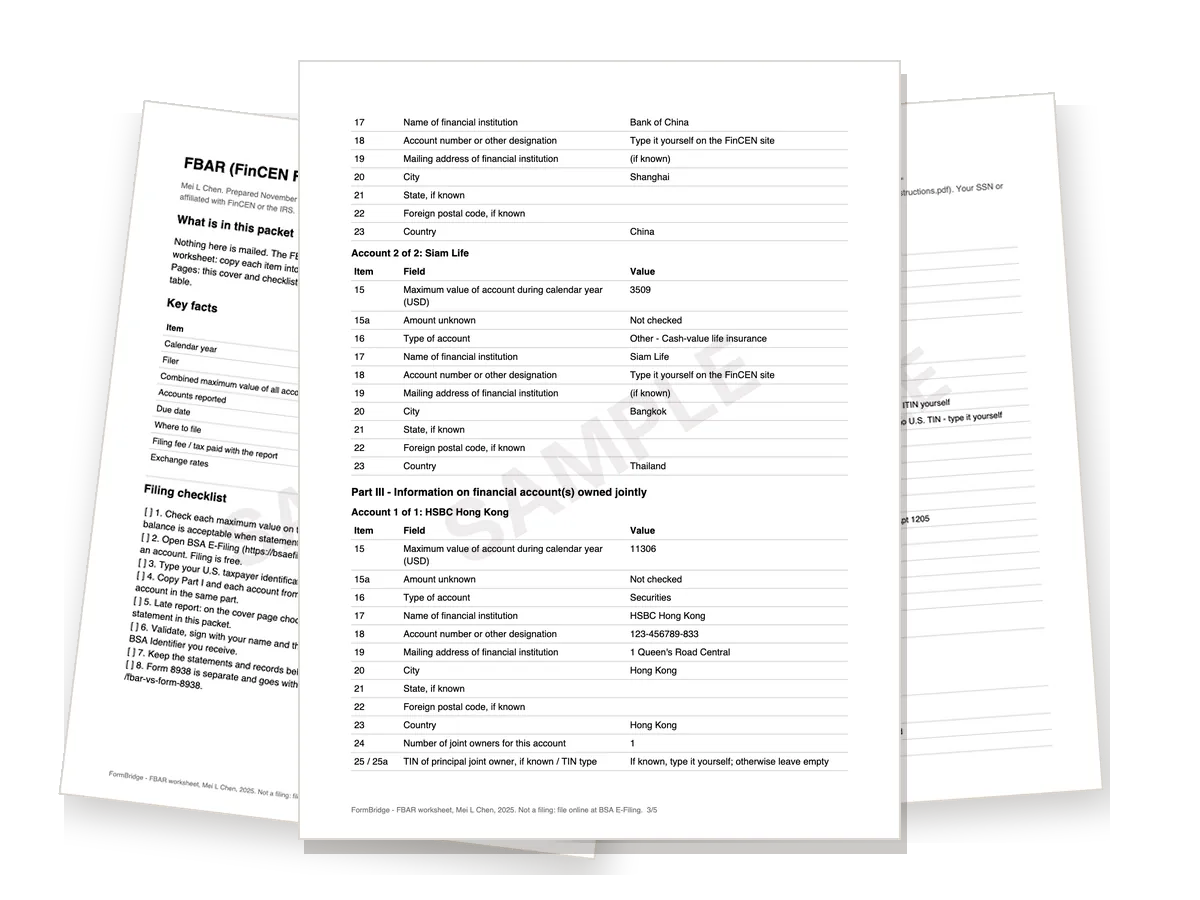
- If you file, the FBAR worksheet wizard takes each account in won, converts it at the Treasury rate, runs the $10,000 test and lays out every item to copy into BSA E-Filing. It is free for an on-time year; you only sign in to download. For a missed year, it builds a late FBAR packet ($79) with a statement of the reason for filing late.
- New to the process? Read the FBAR filing guide. Money in those accounts came from your parents? Read money from parents in Korea and Form 3520.
Worksheet for a self-prepared report; not tax or legal advice. Not affiliated with FinCEN or the IRS. Sources: 31 CFR 1010.350; FinCEN, BSA Electronic Filing Requirements for FinCEN Form 114; IRS, Comparison of Form 8938 and FBAR Requirements; Treasury Reporting Rates of Exchange; 31 CFR 1010.821.
你会拿到什么