Parents sent money from Korea: is it taxed, and what do you file?
Money from parents in Korea is not U.S. income, but over $100,000 in a year means Form 3520. How wires from mom and dad add up, penalties, and Korean gift tax.
Last updated: 2026-11-03
Your parents in Korea wired money for a down payment, helped with a 전세 deposit, or sent your share of an inheritance. Do you owe U.S. tax on it? Usually not. Do you have to tell the IRS? Sometimes, and the penalty for not doing so is large. Korea has its own gift tax and remittance rules, covered briefly below.
The short answer
- No income tax. A gift is not income to you. You do not put it on Form 1040.
- No U.S. gift tax for your parents. U.S. gift tax falls on the giver, and a nonresident alien giving cash from abroad is outside it.
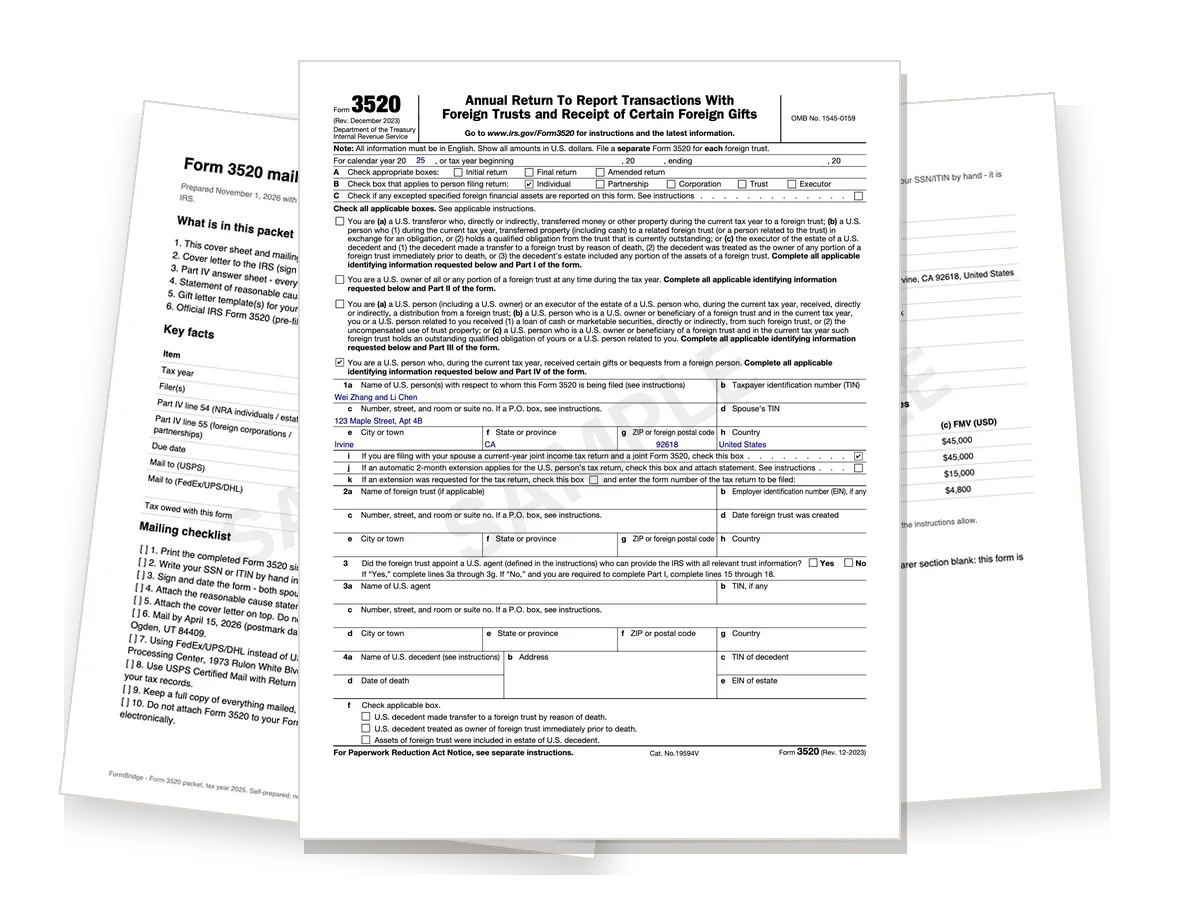
- A report above $100,000. If you are a U.S. person and foreign individuals gave you more than $100,000 in one tax year, you file Form 3520, Part IV. It is an information return: no tax, no payment, just disclosure.
Does this apply to you?
You file only if you were a U.S. person for the year: a citizen, a green card holder, or a resident under the substantial presence test. F-1 and J-1 students are usually nonresidents for their first five calendar years, so gifts in those years are normally not reported.
The giver matters too. Form 3520 Part IV covers gifts from nonresident alien individuals and foreign estates (and, at a lower threshold, foreign companies). If your parents are themselves U.S. citizens or green card holders, their gifts are not reported on Form 3520, even if they live in Seoul.
How the $100,000 adds up
The test is per tax year, and gifts from related people are combined. Related here means your parents, grandparents, siblings, spouse and children, so Mom and Dad count as one donor. For example, for 2026:
| Date | From | Amount (USD at the date received) |
|---|---|---|
| March | Mother, wire from Korea | $45,000 |
| May | Father, wire from Korea | $45,000 |
| August | Grandmother, for closing | $15,000 |
| 2026 | Total, related persons | $105,000: file Form 3520 |
Aunts, uncles and cousins are not "related" under this rule, so their gifts are tested separately. But substance wins: if an uncle or a family friend sends money that is really your parents' money, the IRS treats your parents as the donors, and the form asks whether any donor was acting for someone else.
What counts as a gift
- Wires into your U.S. account or into an account in your name in Korea.
- Money your parents pay on your behalf, such as a down payment sent straight to escrow.
- Property put into your name, such as an apartment in Korea, at its fair market value when you received it.
- Inheritances (상속), which Part IV calls bequests.
A genuine loan is not a gift. A "loan" with no written terms (차용증) that is never repaid looks like a gift, so if your family means it as a loan, write it down and keep the repayment records.
Deadline and penalty
Form 3520 is due on the same date as your income tax return, including extensions, and is mailed separately to the IRS in Ogden, Utah. It cannot be e-filed. Missing it costs 5% of the gift for each month late, up to 25%: on a $200,000 gift, as much as $50,000. Since October 2024 the IRS reads a reasonable cause statement attached to a late form before deciding on a penalty.
The Korean side: gift tax and remittance rules
General information only, based on the National Tax Service's published guidance and current Korean statutes. It is not Korean tax advice. Confirm your situation with a Korean tax professional (세무사) before the money moves.
Korean gift tax (증여세). In Korea the recipient normally pays gift tax. The rules change when the recipient is a Korean non-resident (비거주자) on the date of the gift, as most people living in the U.S. are. Korea decides this by whether you have an address in Korea or a stay of 183 days or more, not by your U.S. status. According to the NTS gift tax overview:
- Property in Korea, such as money in a Korean account: the non-resident recipient owes the tax, and the parent is jointly liable.
- Property outside Korea given by a Korean resident: the giver owes the tax. The exemption for gifts already taxed abroad covers only unrelated people, not parents.
- The NTS calculation guide says the family deduction (증여재산공제) does not apply when a non-resident receives property in Korea. Rates run from 10% to 50%, and gifts from one parent and that parent's spouse within 10 years are added up.
- The return is due within 3 months after the end of the month of the gift, at the tax office for the giver's address.
Korean gift tax does not change the U.S. answer: you still file Form 3520 if gifts passed $100,000.
Remittance rules (외국환거래규정). A gift from a Korean resident to someone abroad is a capital transaction. Under the current regulation, up to USD 100,000 a year (per transfer and in total) can generally be sent without a separate report; above that, the sender may have to report to the Bank of Korea first. Banks also pass remittances above USD 10,000 to the NTS. Your parents' bank will say which documents it needs.
If the money stays in Korea
The gift is one question; where the money sits is another.
- FBAR: if all your accounts outside the U.S. together peaked above $10,000 during the year, you file FinCEN Form 114 online. A Korean savings account in your name holding your parents' gift counts.
- Form 8938: above $50,000 at year end or $75,000 at any time (single, living in the U.S.), attached to your return.
- Interest the money earns after it becomes yours is taxable income on Form 1040.
See FBAR vs Form 8938 vs Form 3520 for how the three fit together, and FBAR rules for Korean bank, pension and insurance accounts for which accounts in Korea count.
What to keep
The IRS does not want bank statements with Form 3520, and it does not require a gift letter. Keep your own file, with no end date:
- Remittance records (송금 내역) from the Korean bank and your U.S. bank.
- A note of who sent what, when, in won and in dollars, and the rate you used.
- A gift letter (or 증여 계약서) saying the money need not be repaid. Your mortgage lender will probably ask for one anyway.
- Any Korean gift tax return and receipt your family filed.
Next steps
- Run the free Form 3520 checker: five questions on your residency, who gave the money, and the total.
- If you need to file, the Form 3520 wizard for foreign gifts builds the line 54 gift table, works out your due date, and gives you the form with a cover letter and Ogden mailing guide. The packet is $79, or $149 for a late year, which adds a reasonable cause statement outline.
- Want to read the form first? See Form 3520 instructions in plain English.
Self-prepared information return. Not tax or legal advice. Not affiliated with the IRS or the National Tax Service of Korea. Sources: Instructions for Form 3520; NTS, 증여세 개요 and 세액계산 흐름도; 상속세 및 증여세법 arts. 4-2, 53, 68; 국제조세조정에 관한 법률 art. 35; 외국환거래규정 arts. 4-3, 4-8, 7-2, 7-46. Verify thresholds and Korean rules for the current year.
What you get