USCIS translation requirements
What USCIS means by a certified translation: full English text plus a translator certificate. Who can translate, notarization, seals, a sample, common mistakes.
Last updated: 2026-10-31
USCIS will not read foreign-language evidence on its own. Every document that is not in English has to come with a translation that meets one short rule, found in 8 CFR 103.2(b)(3).

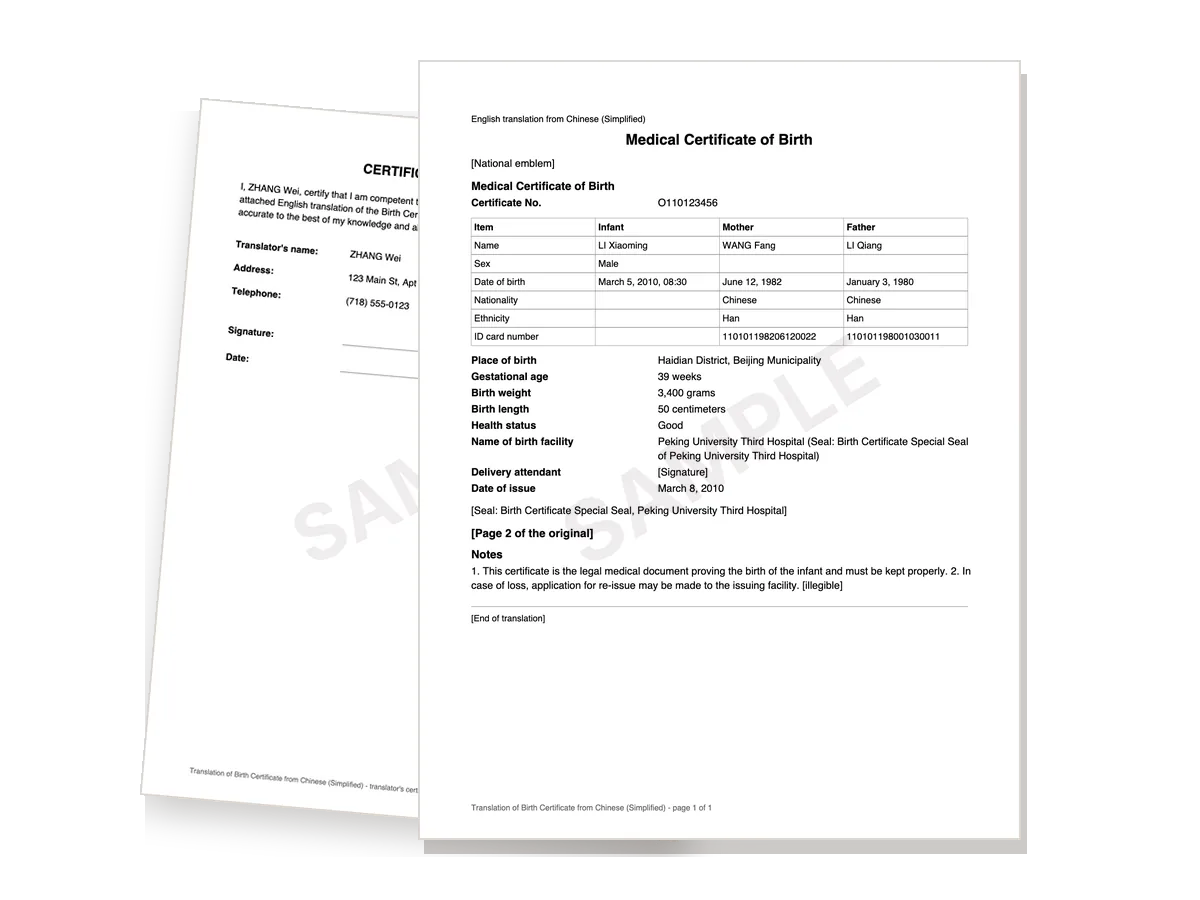
Pages from a sample packet made by our wizard, with made-up data.
The rule
A foreign-language document submitted to USCIS must be accompanied by:
- A full English translation, and
- The translator's certification that the translation is complete and accurate, and that the translator is competent to translate from that language into English.
That is the whole requirement. "Certified" refers to the translator's signed statement, not to a state license or a membership.
What "full" means
- Translate everything on the page: headings, printed text, handwritten entries, footnotes, marginal notes, serial numbers and the issuing office.
- Show seals, stamps and signatures where they appear, in brackets:
[Seal: Civil Affairs Bureau of Chaoyang District, Beijing],[Signature]. Write[illegible]for anything that cannot be read. - No summaries, no extracts, no "translation of the relevant parts". A partial translation is a common reason for a request for evidence.
- Keep the layout recognisable, so an officer can match each line to the original. Tables stay tables.
Who can translate
Anyone fluent in both languages. A friend, relative, colleague or professional translator all qualify. Two practical points:
- If you are the applicant or the beneficiary, the regulation does not stop you, but your own certification invites questions. Ask someone else to review and sign.
- The person who signs is vouching for accuracy. If an AI tool or a friend drafted it, the signer still has to check it line by line.
No notary is required by USCIS. Some states, schools and foreign governments do require notarization, so check before reusing the translation elsewhere.
Sample certificate
Certificate of Translation
I, [full name], certify that I am competent to translate from [Chinese] into English, and that the attached English translation of the [birth certificate] is complete and accurate to the best of my knowledge and ability.
Signature: **____** Date: **____** Name, address and telephone: **____**
Put the translation right after a copy of the original, and the certificate after the translation.
Chinese documents: common mistakes
- Names: use Hanyu Pinyin, the same spelling as the passport. Mixed spellings across documents cause questions.
- Dates: translate the date as written (1990年3月5日 → March 5, 1990). Do not reformat to a different calendar or guess missing parts.
- Hukou: translate the household head page and each page you submit, including the registration stamps.
- Notarial certificates (公证书): they often come with the notary office's own English translation. If an English translation is already part of the certificate, read it against the Chinese before relying on it.
- Seals: every red seal gets a bracketed note with the authority name. Leaving seals out is the most common gap.
Not for Canada
Immigration, Refugees and Citizenship Canada (IRCC) has a different rule: translations by a certified translator who is a member of a provincial or territorial association, or else an affidavit sworn by the translator. A USCIS-style self-certified translation does not meet it.
Let the tool draft it
The USCIS translation tool reads a photo of each page, drafts the full English translation with seals and signatures marked, lets you correct every line, and produces the translation PDF with a certificate page for the translator to sign. $25 a page. See how it works.
Not legal advice. Not affiliated with USCIS. Source: 8 CFR 103.2(b)(3); USCIS form instructions.
What you get