How to file an FBAR, step by step
Who files FinCEN Form 114, which accounts count toward $10,000, converting each maximum at the Treasury year-end rate, and filing free on BSA E-Filing.
Last updated: 2026-10-31
The FBAR is a disclosure, not a tax form. It tells the Treasury which accounts you have abroad and how much was in them at the peak. Income from those accounts still goes on your Form 1040 as usual. The report itself is filed online, costs nothing, and most of the work is finding one number per account.

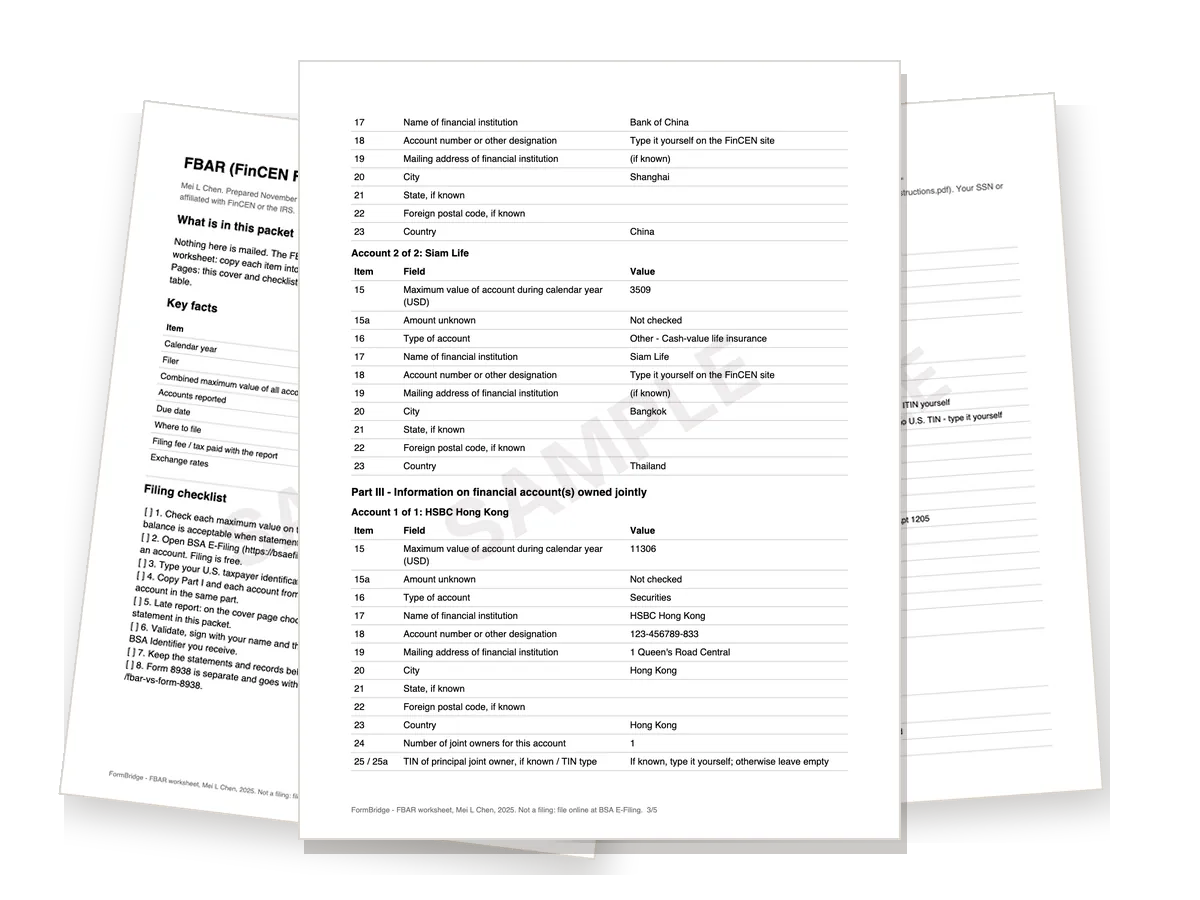
Pages from a sample packet made by our wizard, with made-up data.
Step 1: Check that you have to file
You file an FBAR for a calendar year if all of these are true:
- You were a U.S. person: a citizen, a green card holder, or a resident under the substantial presence test. Children count; a parent can file for them.
- You had a financial interest in, or signature authority over, at least one financial account outside the United States.
- The maximum values of all those accounts, added together, were more than $10,000 at any time in the year.
The test adds each account's own peak, even when the peaks happened in different months. Not sure? The free FBAR checker takes five questions.
Step 2: List the accounts that count
Counted:
- Bank accounts abroad: savings, checking, time deposits
- Brokerage and securities accounts, and mutual fund accounts, at institutions abroad
- Insurance policies with a cash value and annuities held abroad, and many foreign pension accounts
- Accounts you can sign on but do not own, such as a parent's account or your employer's
Not counted:
- Accounts at U.S. institutions, including foreign stocks held through a U.S. broker
- Property held directly, such as an apartment abroad
- Accounts at a U.S. branch of a foreign bank (a foreign branch of a U.S. bank does count: what matters is where the account is)
Step 3: Find each maximum value and convert it
For each account, find the highest balance during the year in its own currency. Month-end statements are fine if they fairly show the peak. Then convert it:
| What | How |
|---|---|
| Exchange rate | Treasury Reporting Rates of Exchange for December 31 of that year |
| Calculation | Foreign amount ÷ rate (units per U.S. dollar) |
| Rounding | Up to the next whole dollar: $15,265.25 becomes $15,266 |
| Negative value | Report 0 |
| Value truly unknown | Tick Item 15a "amount unknown" and keep a note of why |
| Currency with no Treasury rate | Use another verifiable rate and keep its source |
Step 4: Put each account in the right part
| Part | Accounts | Extra items |
|---|---|---|
| Part II | Owned by you alone | Items 15–23: value, type, institution, account number, address |
| Part III | Owned jointly with someone else | Items 24–33: number of joint owners, principal joint owner |
| Part IV | You have signature authority but no financial interest | Items 34–43: the owner's name and address, your title |
Each joint owner reports the full value of a joint account. With 25 or more accounts you may give just the count in Item 14 and keep the details, but you must produce them if asked.
Step 5: File on BSA E-Filing
- Go to BSA E-Filing and choose to file an FBAR. Individuals do not register.
- On the cover page, give the report a name ("Mei Chen 2025 FBAR"), choose New report, and leave third-party preparer unchecked.
- Part I: calendar year, filer type Individual, your SSN or ITIN, date of birth, name and address. Living in the U.S., use your home street address, not a P.O. box.
- Add each account in its part. Use the "+" button for more accounts in the same part.
- Validate, sign electronically on the cover page, submit, and save the PDF copy and the BSA Identifier.
Due date: April 15 of the following year, with an automatic extension to October 15. No request needed. After October 15 the report is late and asks for a reason; see FBAR late filing and penalties.
Keep the statements behind each number for five years from April 15 of the following year.
The FBAR is not Form 8938
Form 8938 is an IRS form that goes with your Form 1040 and has higher thresholds. Many people file both. See FBAR vs Form 8938 vs Form 3520.
Let the wizard do the arithmetic
The FBAR wizard takes each account in its own currency, converts it at the Treasury December 31 rate, rounds up, runs the $10,000 test, sorts every account into Part II, III or IV, and gives you an item-by-item worksheet to copy into BSA E-Filing. Free for an on-time year; catch-up for past years is $79.
Worksheet for a self-prepared report; not tax or legal advice. Not affiliated with FinCEN or the IRS. Source: FinCEN, BSA Electronic Filing Requirements for FinCEN Form 114; Treasury Reporting Rates of Exchange.
What you get