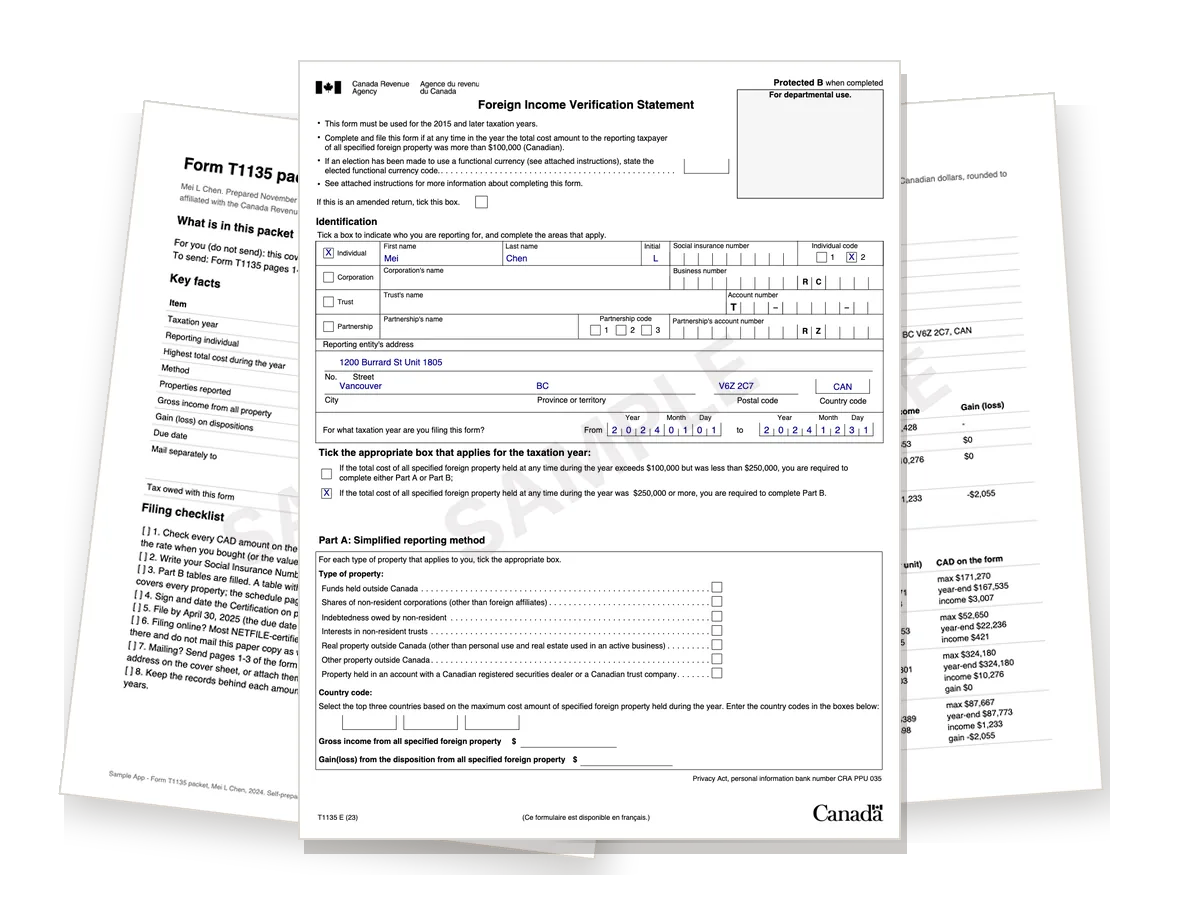
How to fill out Form T1135
Plain-English T1135 walkthrough: who files, the $100,000 cost test, Part A vs Part B, converting foreign currency to CAD, and filing by NETFILE or mail.
Last updated: 2026-10-31
Form T1135 is a disclosure, not a tax calculation. You list what you own outside Canada; the income from it goes on your regular return as usual. The form is three pages, and most of the work is gathering numbers and converting them to Canadian dollars.

Pages from a sample packet made by our wizard, with made-up data.
Step 1: Check that you have to file
You file T1135 for a year if all of these are true:
- You were resident in Canada for tax purposes in that year.
- It is not the year you first became resident. Newcomers skip their landing year.
- The total cost of your specified foreign property was more than $100,000 CAD at any time in the year.
Cost is not today's value. It is what you paid, or the fair market value on the day you became resident (for property you brought with you), or the value when you received it as a gift or inheritance. The test looks at the highest point during the year, not just December 31.
Not sure? The free T1135 checker takes five questions.
Step 2: List what counts
Counted (specified foreign property):
- Bank accounts, deposits and cash held outside Canada
- Shares of non-Canadian companies and foreign funds, even when held through a Canadian broker
- Money owed to you by non-residents: loans, bonds, notes, mortgages
- Interests in non-resident trusts acquired for consideration
- Real estate outside Canada that is rented out or held as an investment
- Other: foreign insurance policies, precious metals held abroad, rights to any of the above
Not counted:
- Personal-use property, such as a home abroad used mainly by you or your family
- Property used only in an active business you run
- RRSP and TFSA holdings, Canadian mutual funds
- Shares of a foreign affiliate (you own 1% and, with related persons, 10%+). Those go on Form T1134 instead.
Our specified foreign property guide has more examples.
Step 3: Convert to Canadian dollars
Work in the original currency, then convert:
| Amount | Rate |
|---|---|
| Maximum funds held / maximum fair market value during the year | Average rate for the year |
| Funds held / fair market value at year-end | Rate at year-end |
| Cost amount (shares, real estate, loans, other) | Rate when you bought it, or when you became resident |
| Income received through the year | Average rate is acceptable |
Round to the dollar. Report nil amounts as 0, not blank. Maximum amounts can be based on the highest month-end figure.
Step 4: Choose Part A or Part B
- Total cost more than $100,000 but under $250,000 all year: you may use Part A, the simplified method. Tick each type of property you held, enter the top three countries by maximum cost, and give total gross income and total gain or loss.
- $250,000 or more at any time: Part B. Each property goes in one of seven tables with its name, country, maximum cost during the year, cost at year-end, income and gain or loss. The printed form has one row per table; attach a schedule in the same format for more.
Category 7 lets you report foreign securities held with a Canadian registered securities dealer as one total per country, using fair market value.
Step 5: Identification and certification
Page 1 asks for your name, Social Insurance Number, address and the taxation year (January 1 to December 31). Individual code 1 means you or your spouse or common-law partner is self-employed; 2 means neither is. Tick the box for the $100,000–$250,000 or $250,000+ range. Page 3 is the certification: print your name, sign and date it.
Step 6: File it
- Due date: the due date of your return, April 30, or June 15 if you or your spouse is self-employed.
- Online: most NETFILE-certified tax software has a T1135 section. Enter the same values there.
- Paper: attach it to a paper return, or mail it on its own to Winnipeg Taxation Centre, Data Assessment & Evaluation Programs, Validation & Verification Section, Foreign Reporting Returns, 66 Stapon Road, Winnipeg MB R3C 3M2.
Missed a year? Read T1135 penalty and late filing.
Let the wizard do the arithmetic
The T1135 wizard takes each account in its own currency, converts it at Bank of Canada rates, tests the $100,000 and $250,000 thresholds, decides Part A or B, and pre-fills the official form with schedules. $79 for the current year.
Self-prepared information return; not tax or legal advice. Not affiliated with the Canada Revenue Agency. Sources: Form T1135 E (23) and its instructions; CRA Questions and answers about Form T1135.
What you get