How to fill out Form T2125
Plain-English walkthrough of CRA Form T2125: who uses it, gross income and GST/HST, expense lines, car and home-office splits, June 15 and April 30 deadlines.
Last updated: 2026-10-31
Form T2125 is the page of your tax return where a self-employed person shows what the business earned and spent. The result, line 9946, is your net self-employment income. Most people never see the paper form: tax software asks the same questions line by line. This guide follows the 2025 form, T2125 E (25); the 2024 form uses the same line numbers.

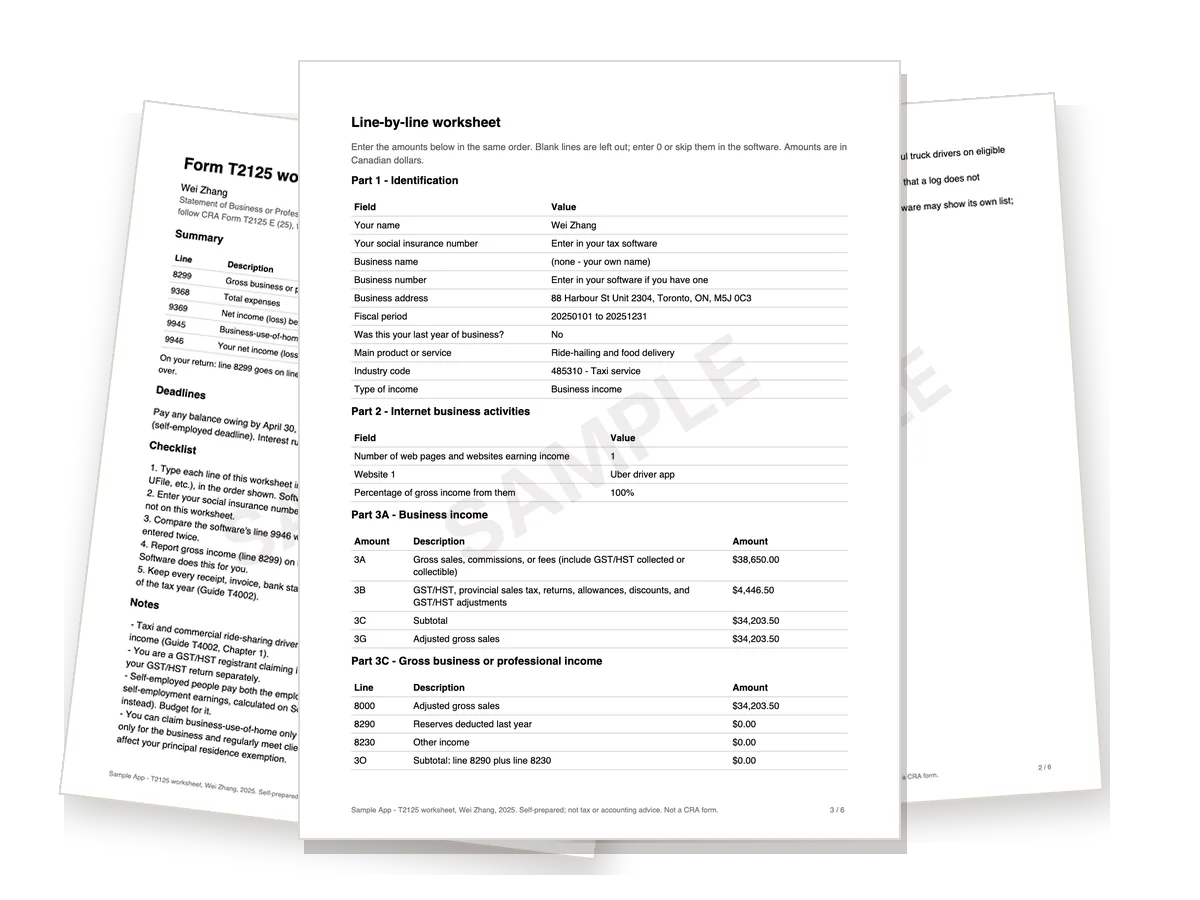
Pages from a sample packet made by our wizard, with made-up data.
Step 1: Check that T2125 is the right form
Use T2125 for business income (selling goods or services), professional income (accountants, lawyers, engineers and other professionals) and commission income. Use a different form for:
- Farming: Form T2042.
- Fishing: Form T2121.
- Rent from property you own: Form T776.
Each business gets its own T2125. If you drive for Uber and also sell on Etsy, that is usually two businesses and two forms.
Step 2: Part 1 and Part 2, identification
Your name, social insurance number, business name (leave blank if you use your own name), business number if you have one, address, fiscal period (January 1 to December 31 for most sole proprietors), main product or service, and a six-digit industry code. CRA lists codes in the appendix of Guide T4002 for paper filers; tax software usually has its own search. Part 2 asks how many websites or platform pages earn you income and what share of gross income came from them.
Step 3: Part 3, income
For business income, line 3A is your gross sales, commissions or fees, including GST/HST you collected. Line 3B removes GST/HST, provincial sales tax, returns, allowances and discounts. Professionals use 3H to 3N instead, the same idea.
Lines 3D to 3F are only for the GST/HST quick method. The total flows to line 8000, then other income (line 8230) and last year's reserves (line 8290) give gross business or professional income on line 8299.
If you sell goods, Part 3D works out cost of goods sold: opening inventory (8300), purchases (8320), direct wages (8340), subcontracts (8360), other costs (8450), minus closing inventory (8500). Gross profit is line 8519.
Step 4: Part 4, expenses
Enter only the business part of each expense. The main lines:
- 8521: Advertising
- 8523: Meals and entertainment (50% of what you spent)
- 8590: Bad debts
- 8690: Insurance
- 8710: Interest and bank charges
- 8760: Business taxes, licences, and memberships
- 8810: Office expenses
- 8811: Office stationery and supplies
- 8860: Professional fees (legal and accounting)
- 8871: Management and administration fees
- 8910: Rent
- 8960: Repairs and maintenance
- 9060: Salaries, wages, and benefits
- 9180: Property taxes
- 9200: Travel expenses
- 9220: Utilities (including business phone and internet)
- 9224: Fuel costs (except for motor vehicles)
- 9275: Delivery, freight, and express
- 9281: Motor vehicle expenses (from Chart A)
- 9936: Capital cost allowance (CCA)
- 9270: Other expenses (specify)
Total expenses are line 9368, and net income before adjustments is line 9369. See our list of T2125 expenses for what goes where.
Step 5: Car and home office
Car (Chart A). Add up the year's fuel, insurance, licence, maintenance, interest and eligible lease costs for the vehicle. Multiply by business kilometres divided by total kilometres, then add business parking and supplementary business insurance. That is line 9281. Interest on a passenger vehicle loan is capped by Chart B: $350 a month for vehicles bought after 2023, $300 for those bought from 2001 to 2023. Keep a logbook.
Home office (Part 7). You can claim it only if the space is your principal place of business, or you use it only for the business and regularly meet clients there. Split heat, electricity, insurance, maintenance, mortgage interest, property taxes and rent by the workspace share of your home (and by hours, if the space is also lived in). The claim on line 9945 cannot be more than your net income at amount 5D: it cannot create or increase a loss. The unused part carries forward to next year.
Step 6: Your net income and the deadlines
Line 9946 is your net income (loss). It goes on line 13500 of your return for business income, 13700 for professional income, or 13900 for commission income; gross income from line 8299 goes on 13499, 13699 or 13899.
- April 30: pay any balance owing.
- June 15: file the return (self-employed deadline).
Self-employed people also pay both the employee and employer shares of CPP contributions on net earnings, through Schedule 8 of the return (QPP in Quebec). And if your taxable sales pass $30,000 in a calendar quarter or over four consecutive quarters, you generally must register for GST/HST. Taxi and commercial ride-sharing drivers must register from the first dollar.
Get it done
The T2125 worksheet asks these questions in plain words, applies the 50% meals rule, the car interest cap and the home-office loss limit, and gives you every line number with its amount to type into your tax software. The summary is free; the full worksheet is $29.
Source: CRA Form T2125 and Guide T4002, Self-employed Business, Professional, Commission, Farming, and Fishing Income. This page is general information, not tax advice.
What you get