Do I need to file Form T1135?
For Canadian residents with bank accounts, stocks, property or other assets outside Canada — including newcomers. Free, nothing stored.
Five questions. Form T1135 is the yearly statement of foreign property for Canadian residents. No tax is paid with it; filing late costs $25 a day, up to $2,500, and much more if CRA finds it was ignored on purpose.
Were you a resident of Canada for tax purposes in that year?
Usually yes if you live in Canada with a home, spouse or dependants here, including new permanent residents and many work or study permit holders.
Did you first become a resident of Canada in that year (landed or moved here)?
At any time in that year, did the total COST of your foreign property exceed CAD $100,000?
Count: foreign bank deposits, foreign stocks and funds (even in a Canadian brokerage), loans to people abroad, rental or investment property abroad, foreign insurance policies, crypto held abroad. Do not count: a home abroad you use mostly yourself, RRSP/TFSA holdings, assets of a business you actively run. Cost means what you paid, or the value on the day you became resident.
Was it $250,000 or more at any time?
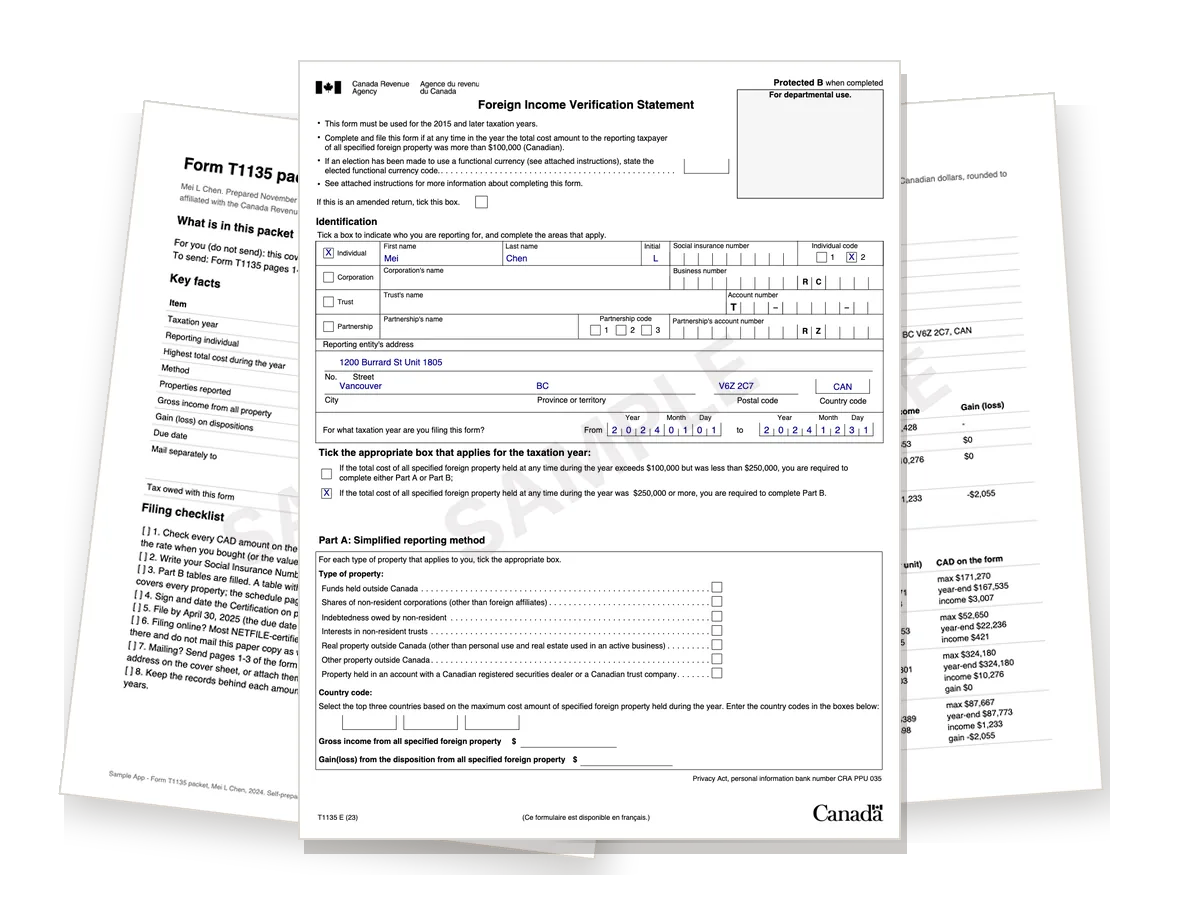
What you get
FAQ
- Who has to file Form T1135?
- Canadian residents whose specified foreign property had a total cost of more than $100,000 (Canadian) at any time in the year. It is filed with the return, even when no tax is owed on that property.
- Do new immigrants file T1135 in their first year?
- No. An individual does not file T1135 for the year they first become resident in Canada. From the next year on, the cost of property brought along is its fair market value on the day you became resident.
- Is the $100,000 based on cost or market value?
- Cost: generally what you paid, or the value when you became resident or received the property as a gift or inheritance. A foreign account worth $90,000 today can still count as over $100,000 if its balance was higher earlier in the year.
- Does a home abroad count?
- Not if it is personal-use property — a home or vacation property used mainly by you or your family. A rental or investment property abroad does count.
- What is the difference between Part A and Part B?
- If the total cost stayed under $250,000 all year, you may use Part A: tick the property types, give the top three countries and total income and gains. At $250,000 or more at any time, Part B lists every property with its country, maximum and year-end cost, income and gain.
- What is the penalty for filing T1135 late?
- $25 a day for up to 100 days, so at least $100 and at most $2,500. Knowingly or through gross negligence failing to file costs $500 a month up to $12,000, and after 24 months a penalty of 5% of the property cost can apply.