Certified translation for USCIS, without the agency
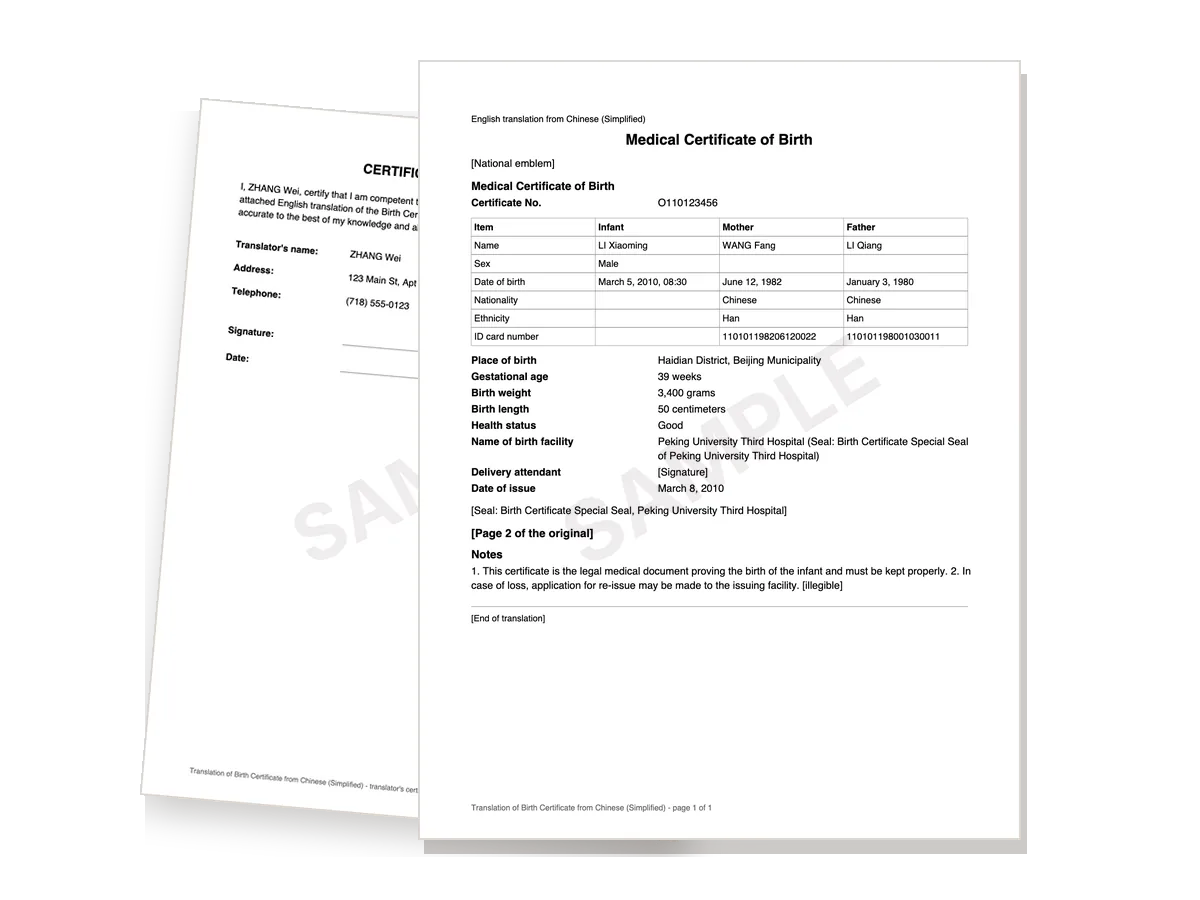
For Chinese and Spanish civil documents: birth, marriage, divorce, household register, police certificates, diplomas. AI drafts the full English translation; you check it; a bilingual person signs the certificate USCIS asks for.
What you get
How it works
1
Photograph one page
Flat, in focus, all corners. HEIC users: export as JPEG.
2
Get a structured English draft
Fields, tables, seals and signatures in the order they appear, with names in pinyin.
3
Review every line
Fix names, dates and numbers against the original. Edit, add or remove rows.
4
Download and sign
Translation PDF plus a Certificate of Translation for the translator to sign and date.
Price
1 page
$25
One page of the original. A second page of the same document adds on.
3 pages
$59
For a hukou, a two-sided certificate, or a birth and a marriage certificate.
Paid in page credits, valid for a year. If the AI cannot read a photo, the credits go back. Edits and re-downloads are free.
Who signs the certificate
USCIS needs a full English translation and a statement from the translator that they are competent in both languages and that the translation is complete and accurate (8 CFR 103.2(b)(3)). Any competent bilingual person can sign. No notary, no agency stamp. Having someone other than the applicant or beneficiary sign avoids questions.
Not covered
- Canada (IRCC): needs a certified translator or a sworn affidavit.
- Court records, notarized packets and multi-page contracts: use a professional translator.
- Anyone who wants us to vouch for the translation: we do not certify; the signer does.
FAQ
- What does USCIS mean by a certified translation?
- A full English translation together with the translator’s signed statement that they are competent to translate from the foreign language into English and that the translation is complete and accurate. It does not mean a state-certified or ATA-certified translator.
- Does the translation need to be notarized?
- No. USCIS asks for the translator’s certification, not a notary. Some other agencies and foreign governments do require notarization, so check where else you will use it.
- Can I translate my own documents?
- The regulation does not forbid it, but a translation certified by the applicant or beneficiary invites doubts about impartiality. It is safer to have another bilingual person review the draft and sign.
- Do I translate the whole document?
- Yes. USCIS wants a full translation, including stamps, seals, handwritten notes and marginal text. Summaries or extracts are not accepted. The draft marks seals and signatures in brackets where they appear.
- Is the AI translation accurate enough?
- It is a draft. Names, dates and ID numbers must be checked against the original by the person who signs, because that person is certifying accuracy. The editor flags any text that still contains Chinese characters.
- Do you keep my document?
- No. The photo is sent to the AI model and dropped after the request. The draft is kept only in your browser until you clear it.