Form 3520 instructions in plain English
What IRS Form 3520 Part IV asks, who has to file it, how the $100,000 threshold works when several relatives send money, and what goes in the line 54 table.
Last updated: 2026-10-29
Form 3520 looks frightening because most of it is about foreign trusts. If a relative outside the United States gave you money, you only touch Part IV, which is two yes/no questions and a short table. This page walks through exactly that.

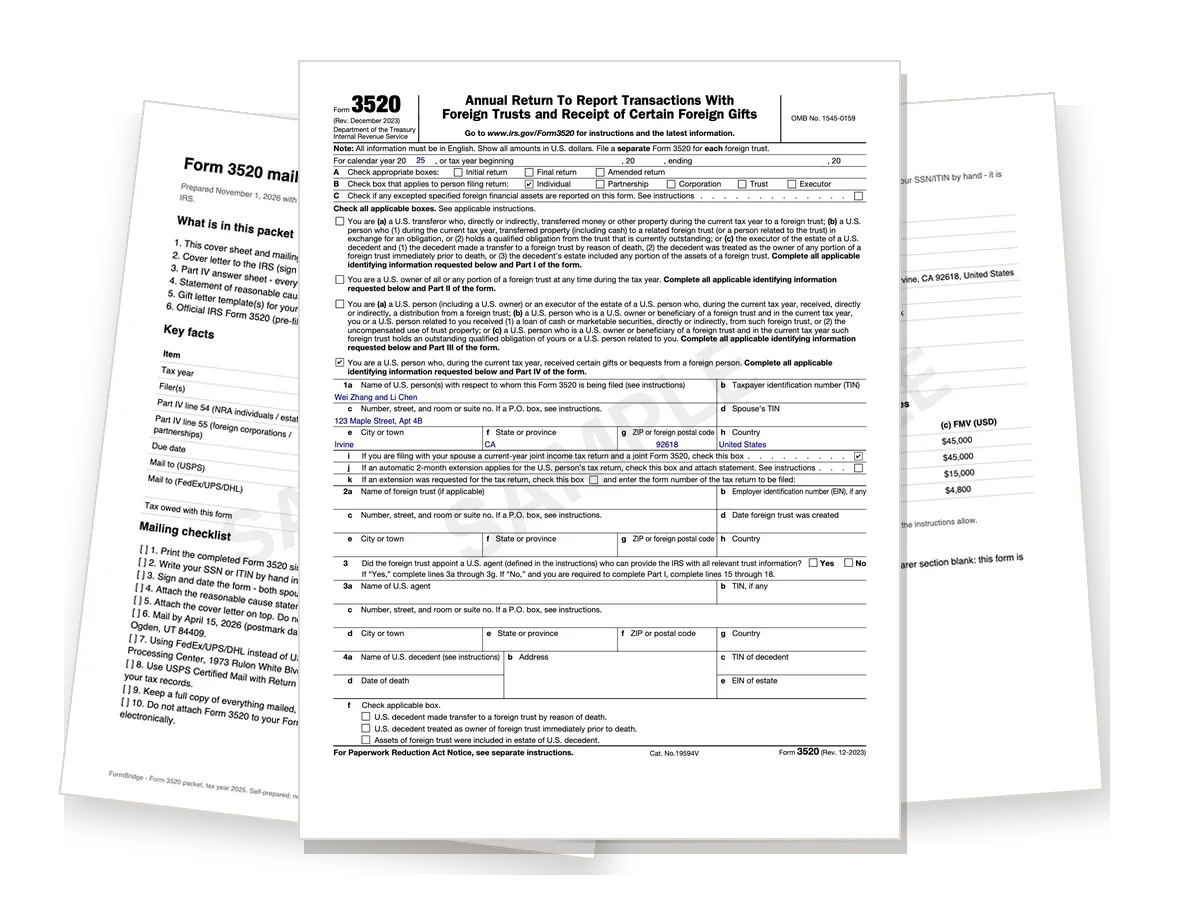
Pages from a sample packet made by our wizard, with made-up data.
Who has to file
You file Part IV for a calendar year if both are true:
- You were a U.S. person for that year: a citizen, a green card holder, or a resident alien because you met the substantial presence test (183 days, counting this year's days plus one-third of last year's and one-sixth of the year before).
- You received, and treated as gifts or bequests, either
- more than $100,000 from nonresident alien individuals or foreign estates, adding together gifts from related people, or
- more than the inflation-adjusted threshold from a foreign corporation or partnership ($19,570 for 2024, $20,116 for 2025; check the instructions for the current year).
Two groups are usually out:
- Nonresident aliens do not file Part IV. F, J, M and Q students are "exempt individuals" for their first five calendar years, so their days do not count toward the 183-day test and they are normally nonresidents.
- Gifts from U.S. citizens or residents are not reported here, even if the giver lives abroad. (The giver may have a Form 709 obligation; that is their problem, not yours.)
Not sure which bucket you are in? The two-minute checker asks the four questions that decide it.
The aggregation rule
This is where people get it wrong. Gifts from related persons are combined. Your mother wires $45,000 in March, your father wires $45,000 in April, and your grandmother sends $15,000 for the closing: that is $105,000 from one family and you must file. The instructions tell you to treat gifts from related parties as if they came from one person.
Unrelated donors are tested separately. But the IRS looks at substance: a "friend" who is passing on your parents' money is a nominee, and line 56 asks exactly that.
Is the gift taxable?
No. A gift is not income to the recipient, and U.S. gift tax, where it applies, falls on the giver. A nonresident alien giving cash from abroad owes nothing. Form 3520 exists so the IRS can see large foreign inflows; it is an information return. You attach no payment.
Part IV, line by line
Top of page 1. Your name as on Form 1040, your address, and your identification number. The wizard leaves the SSN box blank so you can write it by hand; we never collect it. Married filing jointly? You may file one joint Form 3520 and check the joint box; both of you sign.
Parts I to III. Foreign trusts only. Leave them blank.
Line 54. "During the current tax year, did you receive more than $100,000 that you treated as gifts or bequests from a nonresident alien individual or a foreign estate?" If yes, complete the table:
| (a) Date of gift | (b) Description of property received | (c) Fair market value |
|---|---|---|
| 2025-03-14 | Cash wire transfer from mother (China) | $45,000 |
| 2025-04-02 | Cash wire transfer from father (China) | $45,000 |
| 2025-06-20 | Various gifts of $5,000 or less (1) | $15,000 |
List each gift of more than $5,000 on its own line. Smaller gifts can be combined. Use the U.S. dollar value on the date you received it.
Line 55. Gifts from a foreign corporation or partnership above the threshold. For each, you also give the donor's name, address and identification number, and say whether it was a corporation or a partnership.
Line 56. Whether you have reason to believe the foreign donor was acting as a nominee or intermediary for someone else. Usually "No".
Signature. Sign and date at the bottom of page 1. An unsigned form is not a filed form. The paid-preparer block stays empty when you prepare it yourself.
What you do not need
- Supporting documents. You do not mail bank statements with Part IV. Keep them for at least six years in case the IRS asks.
- A gift letter. The IRS does not require one. Your mortgage lender probably does; the packet includes a template.
- Form 709. That is the giver's gift-tax return and only applies to U.S. persons or U.S.-situs property.
Deadline and mailing
Form 3520 is due on the due date of your income tax return, including extensions, and is mailed separately from Form 1040 to the IRS in Ogden, Utah. There is no e-file. The mailing address and deadline page has both addresses and the three possible due dates.
After the deadline
If you are reading this after April 15 and the money arrived last year, you are late. The penalty is 5% of the gift per month, capped at 25%, but the IRS now reads a reasonable cause statement before assessing it. The late filing page explains what to attach.
Do it in ten minutes
The Form 3520 wizard asks for each transfer, applies the aggregation rule, builds the line 54 table, works out your due date, and gives you a packet with a cover letter, checklist and the official form. $79, one tax year, no account needed until you download.
Self-prepared information return. Not tax or legal advice. Not affiliated with the IRS. Verify thresholds in the current Instructions for Form 3520.
What you get