FBAR late filing and penalties
What a missed FBAR can cost, why the non-willful penalty is per report since Bittner (2023), the July 2026 IRS page change, and how to file past years.
Last updated: 2026-10-31
An FBAR carries no tax, and filing it costs nothing. Missing it is what costs money. The penalty depends almost entirely on one question: was the failure willful? Filing the missed years before the IRS asks is the clearest sign that it was not.
The numbers
| Situation | Maximum civil penalty |
|---|---|
| Non-willful failure to file | $16,536 per report (per year, not per account) |
| Willful failure to file | Greater of $165,353 or 50% of the balance at the time of the violation |
| Late but not willful, with reasonable cause, complete report | Generally no penalty asserted |
Amounts are the inflation-adjusted maximums for penalties assessed on or after January 17, 2025 (31 CFR 1010.821). Willful violations can also be prosecuted. The IRS has six years from the violation to assess a civil penalty.
Per report, not per account
Before 2023 the government argued that a non-willful penalty applied to every account on every missed report. In Bittner v. United States the Supreme Court said no: it is one penalty per report. Someone with eight accounts and five missed years faces at most five penalties, not forty.
What changed in July 2026
For years the IRS published "Delinquent FBAR Submission Procedures": if you had reported all the income, were not under examination and had not been contacted, you could file late FBARs with a statement and the IRS said it would not impose a penalty. In July 2026 the IRS removed that page. What remains:
- Late FBARs are still filed electronically on BSA E-Filing, with an explanation of why they are late. On the cover page you pick the reason from a list, or choose Other and type it.
- The published promise of no penalty is gone. IRS guidance for its examiners still says penalties are generally not asserted for a non-willful failure with reasonable cause when the late report is complete.
Which path is yours
- You reported all the income, only the FBAR was missing, and the IRS has not contacted you. File each missed year on BSA E-Filing now, with a short factual statement of why it is late. This is what the catch-up packet prepares.
- Income from these accounts never made it onto your tax returns. A late FBAR alone does not fix that. Look at the IRS Streamlined Filing Compliance Procedures (for non-willful cases) with a tax professional before you file anything.
- The failure may have been willful, or the IRS has already contacted you. Talk to a tax attorney first.
Writing the explanation
Keep it short and factual: what happened, when you learned about the requirement, and what you did next. For example: you moved to the U.S. on a green card and did not know accounts left in your home country had to be reported; you learned of it on a specific date; you reported the interest on your returns; you filed every missed year within weeks. Do not write what you do not know to be true.
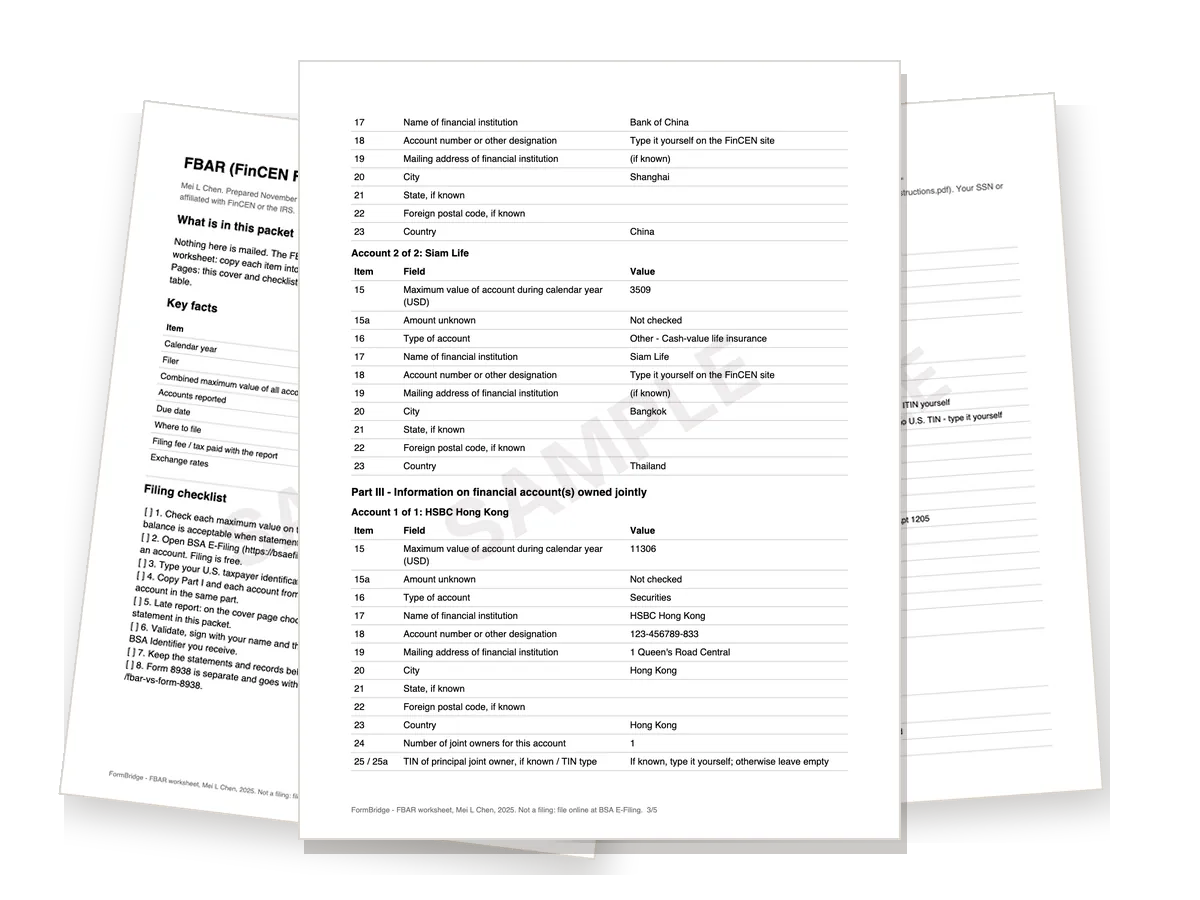
Catch-up packet
The FBAR wizard builds one worksheet per year with that year's Treasury December 31 rates, every account sorted into Part II, III or IV, and a statement of reasons for you to finish and paste into the late-filing box. $79 covers every past year from 2020.
Worksheet for a self-prepared report; not tax or legal advice. Not affiliated with FinCEN or the IRS. Sources: 31 CFR 1010.821; Bittner v. United States, 598 U.S. 85 (2023); FinCEN BSA Electronic Filing Requirements for FinCEN Form 114; IRS: Report of Foreign Bank and Financial Accounts.
What you get