Do I need to file an FBAR?
For U.S. citizens, green card holders and residents with bank or investment accounts outside the United States. Free, nothing stored.
Five questions. The FBAR (FinCEN Form 114) reports foreign bank and investment accounts. It is filed online, it is free, and no tax is paid with it, but missing it can cost up to $16,536 per year even when it was an honest mistake.
Were you a U.S. person that year?
U.S. citizens, green card holders, and anyone who was a U.S. resident for tax purposes (substantial presence test, usually 183+ days counting part of the two prior years). Children too.
Did you have any account outside the United States, or signature authority over one?
Bank accounts, brokerage and fund accounts, cash-value insurance and many pension accounts at institutions abroad, including accounts held for a parent or an employer that you can sign on.
Added together, did the highest balances of those accounts go over $10,000 at any time in the year?
Add each account's highest balance in the year, converted to dollars at the Treasury year-end rate, even if the peaks happened at different times. $6,000 in one account and $5,000 in another is over $10,000.
Was the income from these accounts (interest, dividends) reported on your U.S. tax returns?
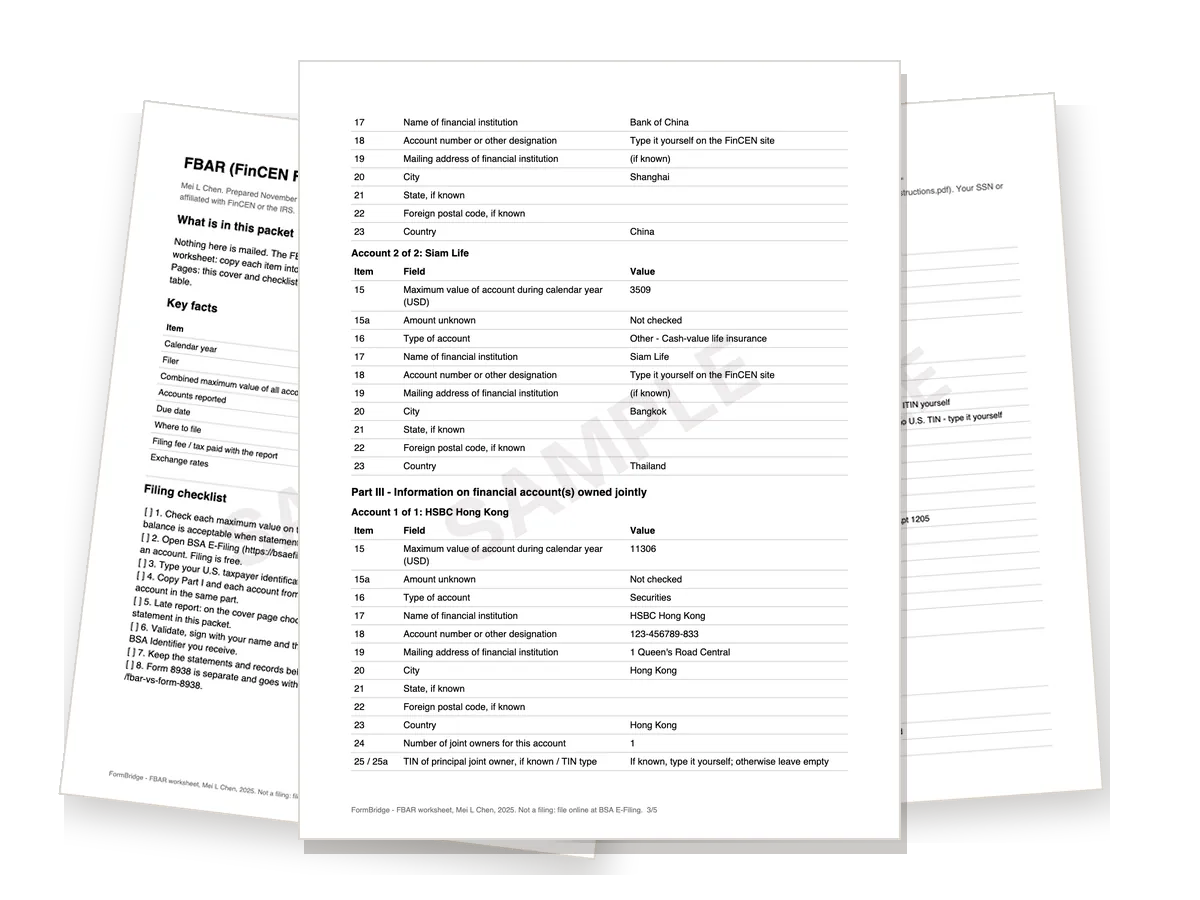
What you get
FAQ
- Who has to file an FBAR?
- A U.S. person (citizen, green card holder, or resident under the substantial presence test) with a financial interest in, or signature authority over, foreign financial accounts whose maximum values added together were more than $10,000 at any time during the calendar year.
- Is the $10,000 per account or combined?
- Combined. Add the highest balance of each account during the year, converted at the Treasury rate for December 31, even if the accounts peaked at different times. Two accounts of $6,000 and $5,000 add up to $11,000, so you file and report both.
- When is the FBAR due and where is it filed?
- April 15 of the following year, with an automatic extension to October 15 that needs no request. It is filed only online, through FinCEN’s BSA E-Filing system, and filing is free. It is not part of your tax return.
- Does an account I share with my parents count?
- Yes. A joint account goes in Part III and each joint owner reports its full value, not a share. An account in your parent’s name that you can sign on counts too, in Part IV.
- What is the penalty for not filing an FBAR?
- Up to $16,536 per year for a non-willful failure (the Supreme Court held in Bittner v. United States, 2023, that it applies per report, not per account). A willful failure costs the greater of $165,353 or 50% of the balance. The IRS generally does not penalize a late report when the failure was not willful and there was reasonable cause.
- Do I also need Form 8938?
- Maybe. Form 8938 is a separate IRS form filed with your Form 1040, with higher thresholds (for a single filer living in the U.S., more than $50,000 at year-end or $75,000 at any time). Many people file both.
How to file an FBAR · FBAR late filing and penalties · FBAR vs Form 8938