New to Canada with property in China: do you file T1135?
Which assets in China count toward the CAD 100,000 T1135 test for newcomers: deposits, stocks, rental flats, the family home. First-year rule and penalties.
Last updated: 2026-11-03
Many families who land in Canada keep money and property in China: a fixed deposit, an A-share account, a flat that is rented out, the apartment parents still live in. Canada asks residents to disclose foreign assets on Form T1135 once they pass CAD 100,000. It is a disclosure, not a tax, but the rules about what counts are specific.
The first year is exempt
You do not file T1135 for the year you first become resident in Canada. If you landed in August 2025, your 2025 return needs no T1135. From 2026 on, you test every year.
Being resident is about your ties to Canada, not only your immigration status. Permanent residents who settle here are usually resident from the day they arrive.
The test
You file for a year when the total cost amount of your specified foreign property was more than CAD 100,000 at any time in the year. Each spouse tests only their own share.
Cost, not value. For anything you already owned when you became resident, the cost is its fair market value on that day. A deposit of RMB 600,000 on your landing day has a cost of about CAD 115,000 at an exchange rate of 5.2 yuan per Canadian dollar (an illustrative rate, not an actual one). For a bank account, the cost amount is in effect the balance, so deposits and interest raise it. For shares and real estate, a later rise in price does not raise the cost; buying more does.
What counts from China
| What you have in China | Counts? |
|---|---|
| Bank deposits, time deposits, wealth management products | Yes: funds held outside Canada |
| A-shares, Hong Kong shares, Chinese funds | Yes |
| Money you lent to relatives or friends in China | Yes: debt owed by a non-resident |
| A flat that is rented out | Yes: real property outside Canada |
| A flat held mainly as an investment | Yes |
| The flat your parents live in, or that you use on visits | No: personal-use property |
| Property in your parents' names | No: you do not own it |
| Cash-value insurance policies from Chinese insurers | Yes: other property |
A flat that sits empty is the hard case. The test is its primary use, and CRA gives no bright line. If you keep it mainly to use when you go back, it leans personal-use; if you keep it mainly to rent or sell at a gain, it counts. Write down how it is used.
Our specified foreign property guide lists more examples, including RRSP/TFSA holdings and Canadian funds that invest abroad.
Part A or Part B
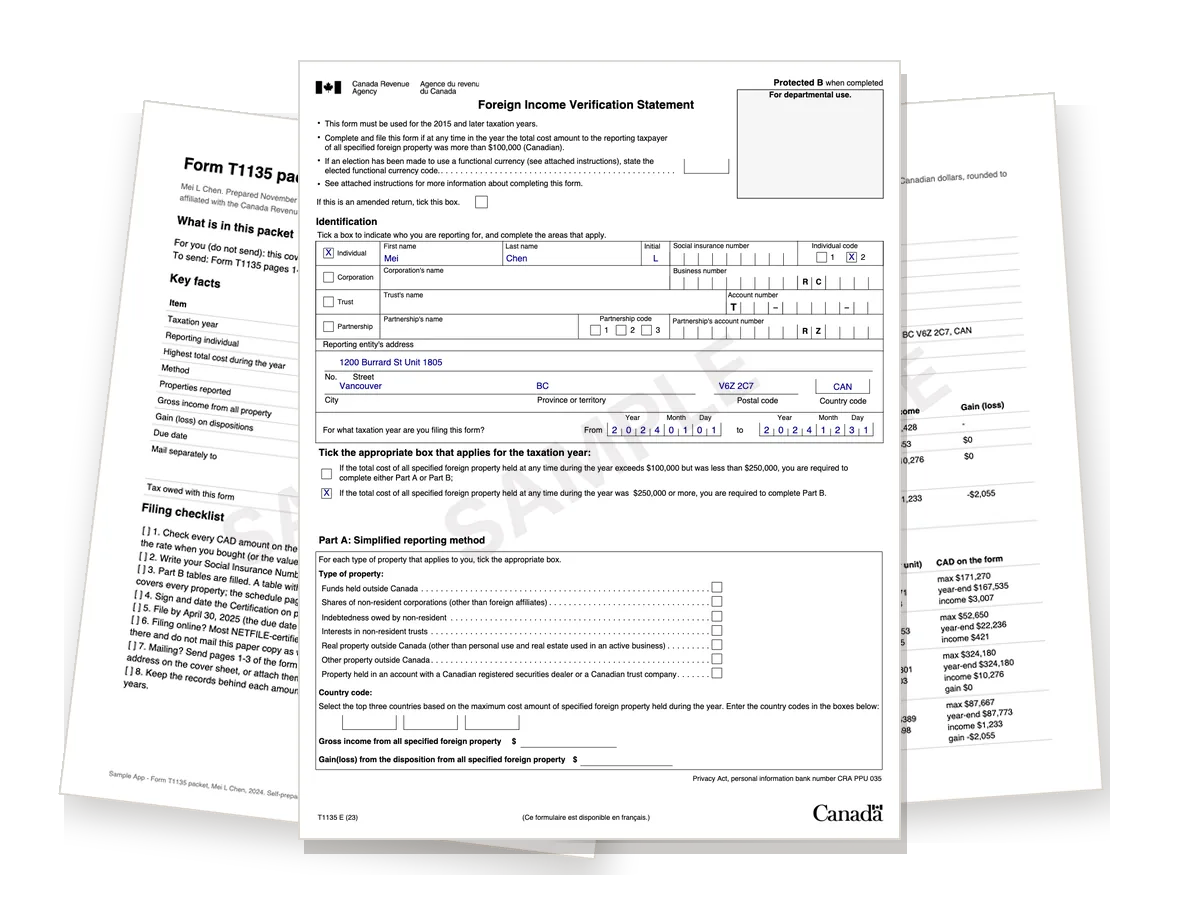
- Total cost above CAD 100,000 but below CAD 250,000 throughout the year: Part A, the simplified method. Tick the types of property, name the top three countries, and give total income and gains.
- CAD 250,000 or more at any time: Part B, property by property, with country, maximum cost, year-end cost, income and gain or loss.
Due date and penalties
T1135 is due with your return: April 30, or June 15 if you or your spouse is self-employed. Most NETFILE software supports it; it can also be mailed. The penalty for a late form is $25 a day for up to 100 days, maximum $2,500 per year. Knowing or grossly negligent failures can cost far more, and if foreign income was also left off your return, CRA gets three extra years to reassess. See T1135 penalties and late filing.
Income still goes on your return
T1135 only discloses. As a Canadian resident you report worldwide income on your T1: interest from Chinese deposits, dividends, rent from the flat, and gains when you sell. Chinese tax paid on that income may give you a foreign tax credit. If you sell the flat later, its cost for Canadian tax purposes is generally the value on the day you became resident, so a professional valuation from around your landing date is worth keeping.
Side note: newcomer benefits
Applying for the Canada child benefit or the Canada Groceries and Essentials Benefit as a newcomer (Forms RC66 and RC151) asks for your world income for the period before you arrived. That is a different form with a different purpose. The free RC66 and RC151 newcomer benefits checker tells you which form to send and which years of income to list.
Next steps
- Run the free T1135 checker: it handles the first-year exemption and the cost test.
- If you file, the T1135 wizard takes each item in RMB, converts it at Bank of Canada rates, picks Part A or B, and pre-fills the official form.
Self-prepared information return; not tax or legal advice. Not affiliated with the Canada Revenue Agency. Sources: Form T1135 and its instructions; CRA Questions and answers about Form T1135.
What you get