Chinese bank accounts, Yu'e Bao, Alipay and WeChat Pay: what goes on the FBAR
Which accounts in China count toward the $10,000 FBAR test: bank cards, time deposits, brokerage, funds, Yu'e Bao, and the unsettled case of e-wallets.
Last updated: 2026-11-03
Most people who moved from China still have money there: a debit card from before they left, a time deposit their parents opened, a brokerage account, some change sitting in Alipay. If you are now a U.S. person, all of it may belong on the FBAR (FinCEN Form 114). The report is free and owes no tax. Missing it is what costs money.
Who files
You file an FBAR for a calendar year if:
- You were a U.S. person: citizen, green card holder, or resident under the substantial presence test. F-1 and J-1 students are usually nonresidents in their first five calendar years and do not file.
- You had a financial interest in, or signature authority over, accounts outside the United States.
- The highest balance of each account, added together, was more than $10,000 at any time in the year.
The test adds each account's own peak, even when the peaks fell in different months. $10,000 is a low bar: RMB 75,000 spread across three cards can cross it.
What counts in China
| Account | Counts? |
|---|---|
| Bank debit card (savings / current), time deposits, large CDs | Yes |
| Bank wealth management products held in your bank account | Yes, as part of that account |
| Securities account (A-shares), fund accounts at a fund company | Yes |
| Insurance with a cash value, annuities (savings-type policies) | Yes |
| Yu'e Bao, Lingqiantong and other money market funds | Conservatively yes: they are pooled funds sold to the public |
| Plain Alipay or WeChat Pay balance | Unsettled, see below |
| Housing provident fund, social insurance personal account | No specific guidance; practice varies |
| An apartment, or cash at home | No: not an account |
Ownership is about whose name is on the account, not whose money it is. A card in your name that your parents use is yours. Your parents' own accounts are not, unless you can sign on them, which would put them in Part IV of the form.
Alipay and WeChat Pay: the honest answer
The FBAR regulations define a financial account as a bank account, a securities account, or an "other financial account", which includes accounts with mutual funds or similar pooled funds and cash-value insurance. They say nothing specific about stored-value e-wallets, and FinCEN has not issued clear guidance on whether a balance held with a payment company like Alipay or Tenpay (WeChat Pay) is reportable. Professionals disagree.
What is clear:
- The bank cards linked to your wallet are bank accounts and count on their own.
- Yu'e Bao and Lingqiantong are money market funds, not just a wallet balance, and fit the pooled-fund category.
The conservative approach most careful filers take: include the plain wallet balance in the $10,000 test and list the account (in Part II, with the payment company as the institution). There is no penalty for reporting an account you did not strictly need to report; the penalties are for leaving out accounts you should have reported. If your wallet balance is a few hundred yuan and your other accounts are far below $10,000, the question does not change your answer.
Working out the number
For each account, find the highest balance during the year in RMB. Month-end statements are fine if they fairly show the peak. Convert it with the Treasury Reporting Rate of Exchange for December 31 of that year, and round up to the next dollar. For example, if the year-end rate were 7.2 yuan per dollar, a card that peaked at RMB 50,000 is $6,945, and a fund account that peaked at RMB 30,000 is $4,167: $11,112 together, over the line.
Filing
- Where: online through FinCEN's BSA E-Filing system. Not with your tax return, and not by mail. There is no fee.
- When: April 15 of the following year, with an automatic extension to October 15.
- Penalty: a non-willful failure can cost up to $16,536 per report (amount assessed on or after January 17, 2025); willful failures are far worse. See FBAR late filing and penalties.
Above $50,000 at year end or $75,000 at any time (single, living in the U.S.), you probably also attach Form 8938 to your return. Interest and gains from these accounts go on Form 1040 either way. See FBAR vs Form 8938.
Next steps
- Run the free FBAR checker: five questions, nothing stored.
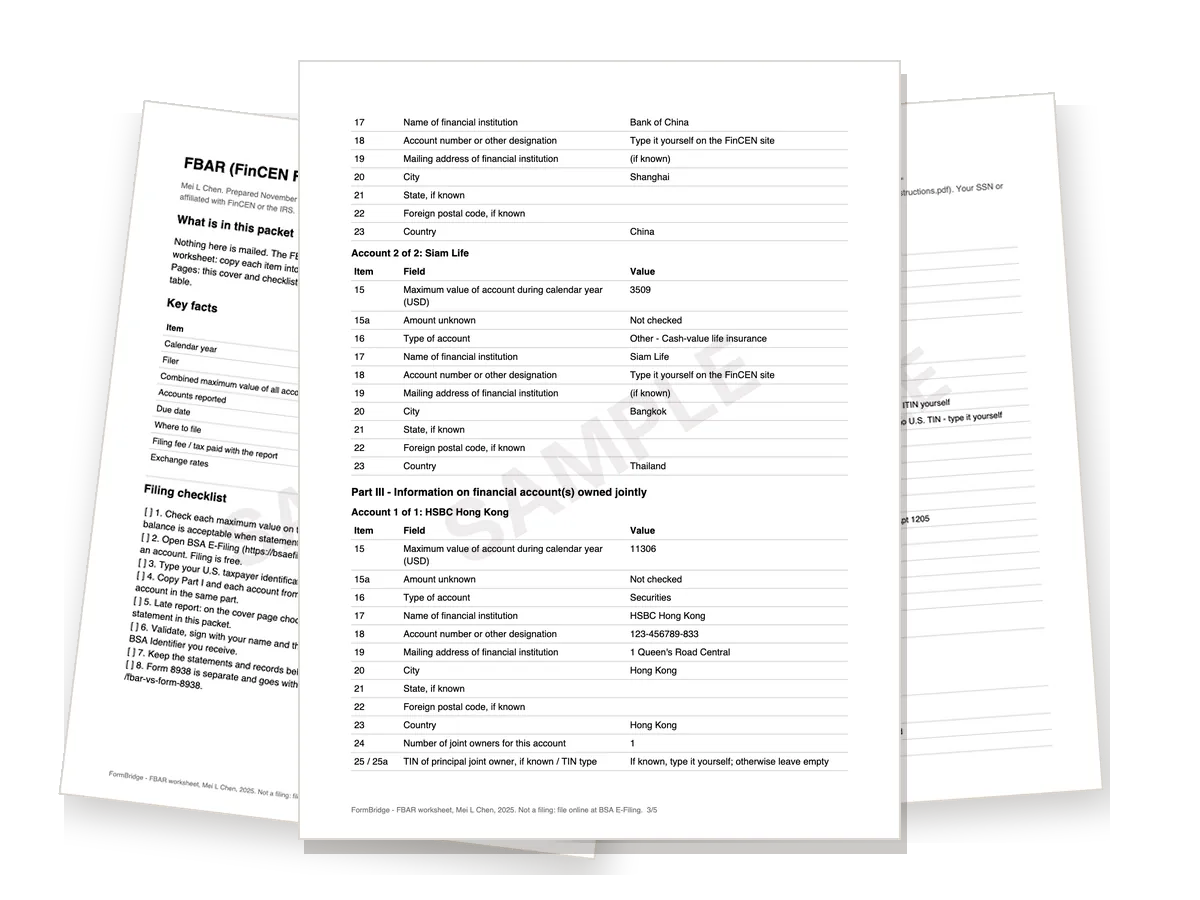
- If you file, the FBAR worksheet wizard takes each account in RMB, converts it at the Treasury rate, runs the $10,000 test and lays out every item to copy into BSA E-Filing. It is free for an on-time year; you only sign in to download.
- Money in those accounts came from your parents? Read money from parents in China and Form 3520.
Worksheet for a self-prepared report; not tax or legal advice. Not affiliated with FinCEN or the IRS. Source: 31 CFR 1010.350; FinCEN, BSA Electronic Filing Requirements for FinCEN Form 114.
What you get