Translating a hukou, birth notarial certificate or marriage certificate for USCIS
Do Chinese documents for USCIS need a translation agency or a notary? What 8 CFR 103.2(b)(3) requires, who can translate, and handling hukou pages and seals.
Last updated: 2026-11-03
Green card, citizenship and family petitions all ask for Chinese civil documents: the household register (hukou), a notarial birth certificate, a marriage certificate. The common questions are the same every time: do I need a translation company, does it have to be notarized, and what do I do with all the red seals? The rule is shorter than most people expect.
What USCIS actually requires
Under 8 CFR 103.2(b)(3), any document in a foreign language must come with:
- a full English translation, and
- the translator's certification that the translation is complete and accurate and that the translator is competent to translate from Chinese into English.
That is all. USCIS does not require:
- a translation company or an ATA-certified translator;
- notarization of the translation or the certificate;
- a separate certificate on every page; one certificate can cover a multi-page document.
"Certified translation" here means the translator's signed statement, not a license. See USCIS translation requirements for the general rule and a sample certificate.
Who should translate
Anyone fluent in both languages: a friend, a relative, a colleague, or a professional. The one thing to avoid is signing your own: the regulation does not forbid it, but a certificate signed by the applicant or beneficiary invites questions about impartiality. Have someone else translate, or at least review it line by line and sign. Whoever signs is vouching for accuracy, even if a tool drafted it.
Which Chinese document to submit
Translating is the second question; the first is whether you have the right document. For events such as birth, Chinese records are often submitted as notarial certificates (公证书) issued by a notary office, alongside the hukou and the marriage certificate itself. The U.S. Department of State's reciprocity page for China lists which documents are available and acceptable for each event. Check it and the form instructions before you order anything.
Document by document
Hukou (household register). Translate the cover information, the household head page, and every page you submit, including your own page. Keep every field, even empty ones: relationship to the head of household, former names, date and reason of moving in, and each registration stamp. Former names matter: if a name appears that is not on your passport, the officer will want to know who it is.
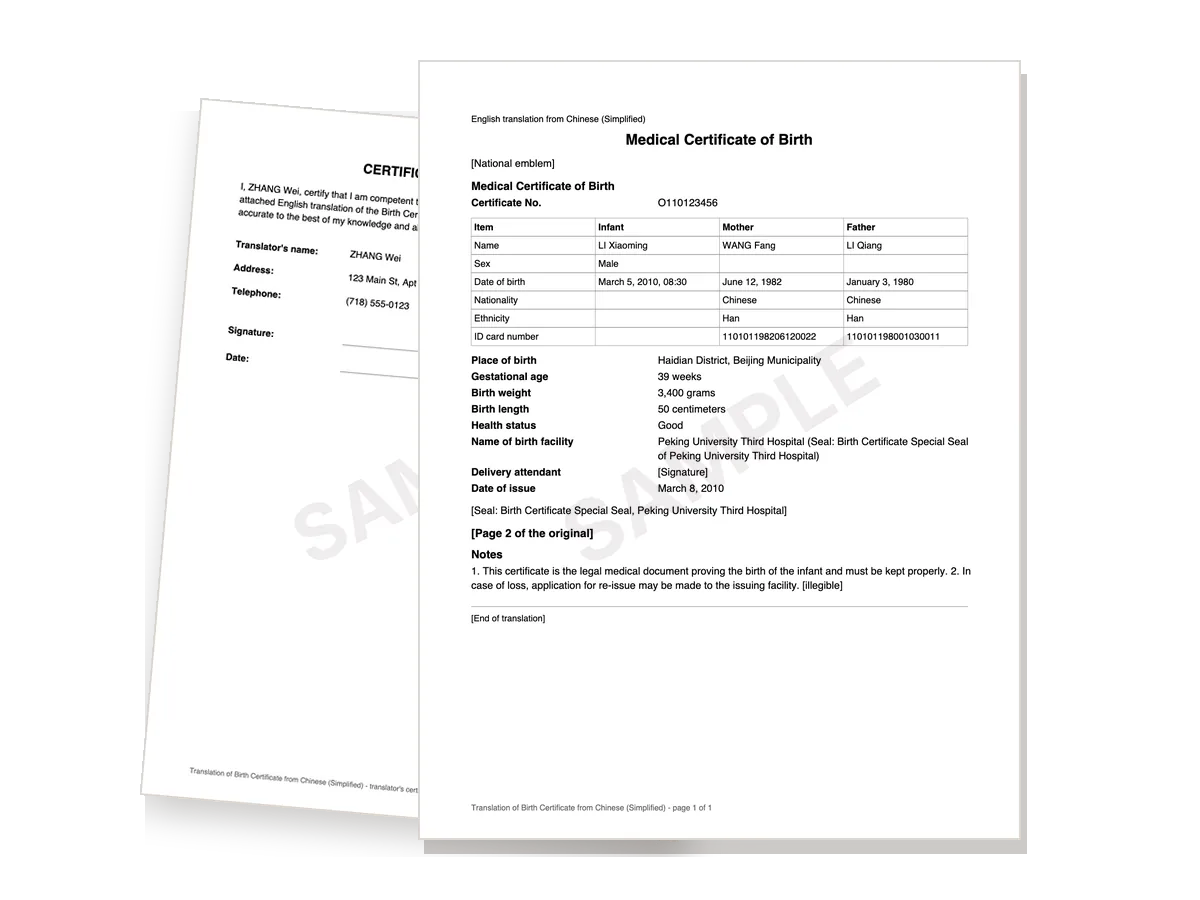
Notarial birth certificate. Many notary offices issue the certificate with their own English translation attached. Before relying on it, check that it translates everything, including any attached photocopy of an underlying record, and that names and dates match the passport. If something is not translated, translate that part and add your certificate.
Marriage certificate. Translate both inside pages: the holder's details, both spouses' names, ID details, registration date and number, the issuing office, the photo caption, and the seal. An embossed seal over the photo goes in brackets too: [Embossed seal: ...].
Details that cause requests for evidence
- Names in Hanyu Pinyin, spelled exactly as in the passport, in the same order on every document.
- Dates as written: 1990年3月5日 becomes March 5, 1990. Do not guess missing parts.
- Every seal in brackets with the authority's name:
[Seal: Public Security Bureau of ...]. Leaving seals out is the most common gap. - Handwritten notes and stamps in the margins are part of the document. Translate them; write
[illegible]where you cannot read them. - Order: a clear copy of the original, then the translation, then the certificate. Send copies, not originals, unless the instructions or a request for evidence ask for the original.
Not for Canada
IRCC applies a different rule: a certified translator who belongs to a provincial or territorial association, or an affidavit from the translator. A USCIS-style certificate does not meet it.
Let the tool draft it
The USCIS certified translation tool reads a photo of each page, drafts a full English translation with seals and signatures marked, lets you correct every line, and produces the translation with a certificate page for the translator to sign. See how certified translation for USCIS works.
Not legal advice. Not affiliated with USCIS. Source: 8 CFR 103.2(b)(3); USCIS form instructions; U.S. Department of State reciprocity schedule for China.
What you get